
The planning exercises in the Tend Planner are designed to support your passions, whether that’s yoga, photography, running, writing, printmaking, or anything else. We call these “streams” because they flow through your life.
The first worksheet you’ll find in your Tend Planner is an opportunity to think about your streams to better understand why you find them motivating or fulfilling. That can help us to better fit these passions into our lives.
There is space in the planner for four streams. For most people, more than four streams gets overwhelming, but you can always use some of the notepaper at the end of the planner if you need more space.
Getting Started
To start the exercise, write the thing you’re passionate about at the top of the page, and put down a few sentences about what role that activity plays in your life. It could be a hobby, it could be an all-consuming obsession, maybe you’ve made it into your career, maybe it’s the thing you would do if you didn’t have to work.
Here’s an example from a recreational runner:
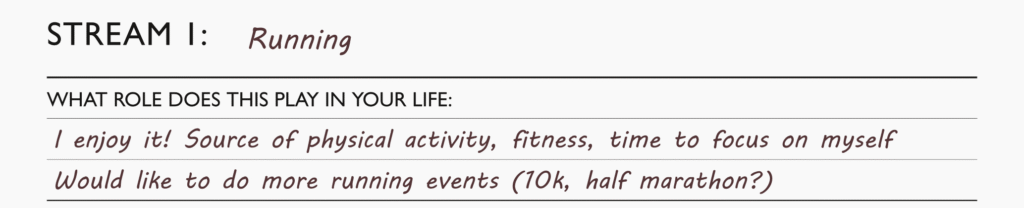
This doesn’t have to capture every nuance of this activity in your life, just give a bit of context about how it fits in with everything else you’re doing.
Describe the Highlight Reel
The Tend Planner approach of focusing on process over goals tries not to get too carried away with the “big” moments of our passions, but it’s still helpful to think about what this activity is like in its best moments.
For our runner, this could look something like:
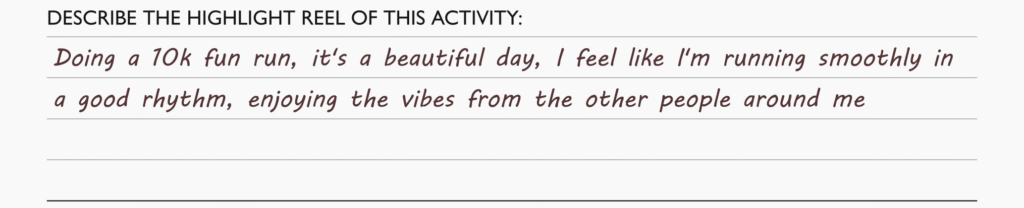
For some people, these highlight experiences are enough to motivate them through months of day to day slogging. But for most of us, we have to enjoy the day to day stuff or we won’t do the activity. Now we know what we’re aiming for, let’s think about how we get there.
The Activity on a Normal Day
What does this activity look like when it’s not the highlight reel? For our runner, trying to get time away from the family to sneak in a run before work, it could looks something like this:
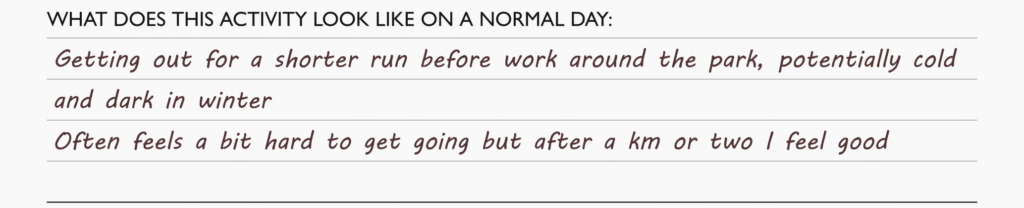
An early start for a cold, dark run doesn’t sound as fun as buzzing your way through a sunny fun run.
Think about your own day-to-day experience of your activity. What is that like? How does it resemble the highlights? How is it different? What’s the range of experiences? Are there good days and bad days?
What’s Good About the Everyday Experience?
What gets you motivated to do your activity on a normal day? Are you just slogging towards a goal, or are there things you appreciate or enjoy about the process?
For our runner, it could be:
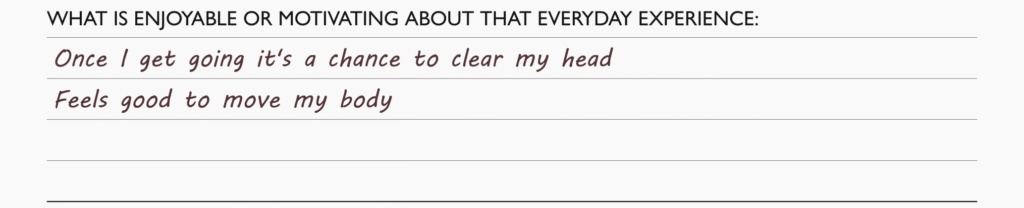
Spend some time thinking about this. For some people (like our runner) this might not be very complicated – if you like running, then going running is probably enjoyable. But for a musician who enjoys performing and the energy of the crowd, sitting in your room practicing alone might not be so appealing.
Hopefully, if this activity is truly important to you there is something in there that you enjoy. Maybe it’s taking time to yourself, or a chance to master something, or learn something new, or be creative. If you can identify that thing you can use it as the foundation for a fulfilling, consistent and sustainable process.
Other Benefits of the Activity
For a lot of our passions the activity itself is only part of what we love. Our passions can also be a way to make friends, stay fit, feel good about ourselves, or even make money.
Our runner loves running, but it also gives them other benefits:
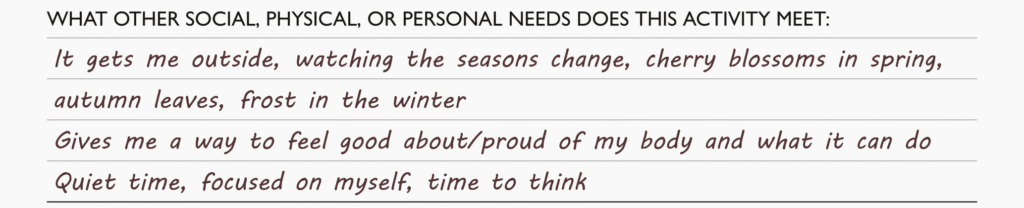
These things matter when we try to build consistent and sustainable processes. If running connects you with nature, it might not work to train by running on a treadmill in a gym. If you mostly see your friends at a yoga class, it probably won’t work to switch to one-on-one instruction or a lot of solo practice.
A sustainable process must respect your needs. Understanding these needs will help you to maintain a healthy relationship with your passions so that they serve your life, rather than the other way around.
Changes and Goals
There’s space to quickly list any important changes or goals you’re aiming for in your activity this year.
For our runner, this could be:

This isn’t intended to be a place for a major goalsetting exercise. Instead, we want to note anything that might influence the kind of process we try to build. If you’re thinking of doing a half marathon, you might need to increase the frequency and distance of your day-to-day runs.
The Tend Planner approach is to build a good process and let the goals follow from that. If you’re enjoying getting out and running consistently it’s more achievable to aim that existing process towards a half marathon than to start training from scratch.
Summary
Here we want a quick summary of the things that make this activity enjoyable and fulfilling day-to-day. That will likely be a combination of enjoyable parts of the activity itself, other benefits it provides, and ways that it connects to the highlight experiences of the activity at its best.
In our example, these are:
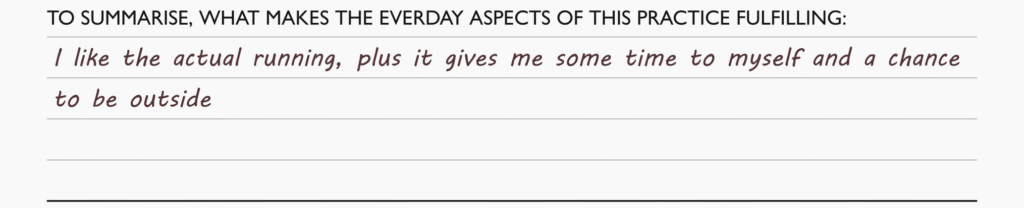
This doesn’t have to be a deep exposition of the human soul. We just want some guidelines we can refer back to so that when we’re planning these activities through the year.
Understanding our passions and ourselves gives us the best chance of designing processes we can love. And loving the process is the best way of sticking to it. Good luck!